
You’ll find N₂O concentrations are measured using multiple advanced techniques in 2025, including cavity ring-down spectroscopy (CRDS) for parts-per-billion sensitivity, quantum cascade lasers (QCL) achieving 0.3 ppbv precision, and Fourier-transform infrared (FTIR) systems spanning 850-7000 cm⁻¹. Chamber-based methods combine with eddy covariance techniques for high-frequency (10 Hz) flux measurements, while isotope analysis enables source attribution. Modern field deployments integrate these technologies with cloud-based platforms for detailed emissions monitoring. The latest innovations in sensor networks and spectroscopic systems offer even more sophisticated measurement capabilities.
Current Methods for N₂O Detection and Analysis

While numerous methods exist for measuring nitrous oxide concentrations, five primary analytical techniques dominate the field in 2025: sorbent-stabilized sampling, infrared detection, gas chromatography, cavity ring-down spectroscopy, and off-axis integrated cavity output spectroscopy.
The sorbent stabilized sampling benefits include reduced workload through linear concentration assumptions and pooled samples, achieving strong correlations (R²=0.91-0.95) with traditional methods. Modern detectors utilizing infrared sensors can accurately detect N₂O molecules in real-time for continuous workplace monitoring. You’ll find infrared sensor calibration strategies focus on CO₂ interference mitigation, offering 5-10+ year lifespans. These monitoring techniques are crucial since N₂O is a potent greenhouse gas that traps heat in the atmosphere 300 times more effectively than CO₂ over a century.
Gas chromatography delivers high sensitivity for low N₂O concentrations, while CRDS provides continuous monitoring through precise light decay measurements. OA-ICOS stands out for harsh environments, offering improved stability over CRDS despite lower output intensity. Each method presents unique advantages, from simplified sampling to real-time monitoring capabilities.
Traditional Chamber-Based Measurement Systems

Although traditional chamber-based measurement systems have long served as a cornerstone of N₂O flux monitoring, modern implementations combine static chambers with advanced analytical tools for improved accuracy. Chamber material selection and closure mechanism considerations remain critical for reliable measurements, with PVC or metal collars inserted into soil serving as standard options. Gas chromatography analysis of collected samples provides precise quantification of N₂O concentrations. This advanced monitoring approach helps track GHG emissions patterns across diverse farming systems.
Static chambers utilize carefully designed sealing mechanisms and gas collection ports, ensuring proper containment of emissions during sampling periods. Chamber volume calculations require precise height measurements at multiple points, accounting for the total enclosed air space used in flux determinations. The evanescent nature of nitrous oxide emissions makes continuous monitoring particularly challenging with these systems. Integrated soil moisture and temperature sensors within chambers provide essential environmental data alongside N₂O measurements.
You’ll find these systems particularly effective when combined with high-frequency analyzers like the Aeris MIRA Ultra, though traditional setups still face challenges with episodic emission capture and labor-intensive sampling requirements.
Advanced Spectroscopic Techniques in Field Studies
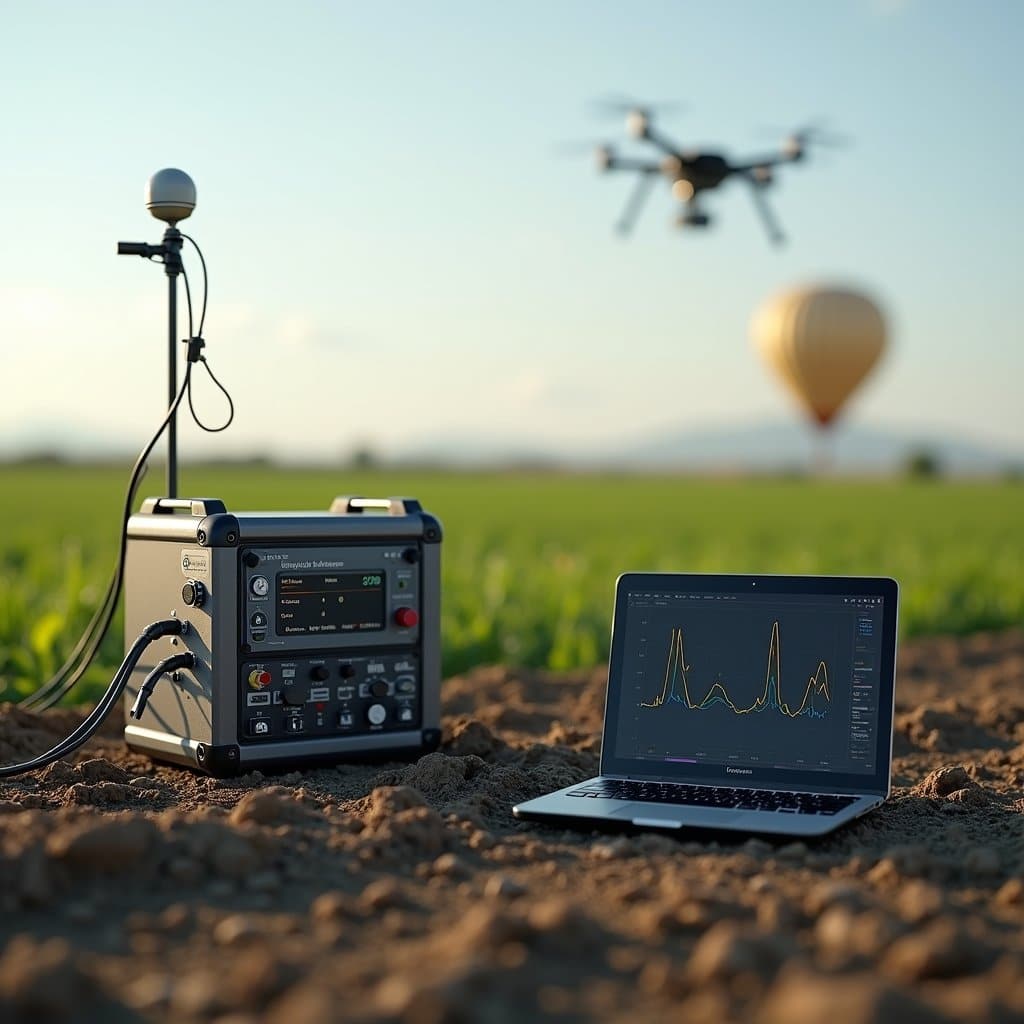
You’ll find CRDS-based analyzers revolutionizing field measurements through their ability to simultaneously monitor N₂O, CO, and H₂O in challenging marine environments.
QCL systems, when integrated with OA-ICOS configurations, enable high-precision airborne detection of N₂O at altitudes up to 18 km with measurement frequencies exceeding 1 Hz.
The COPS system utilizes an ultra-broadband mid-infrared light source for superior detection capabilities across multiple greenhouse gases.
Multi-gas FTIR applications have expanded to include open-path systems at wastewater treatment facilities, where they’re providing spatially integrated measurements of CH₄, CO₂, and N₂O emissions in real-time.
CRDS Field Deployment Benefits
Several breakthrough benefits make CRDS field deployment an indispensable tool for N₂O measurement in 2025. With improved cavity design and advanced data processing techniques, you’ll achieve parts-per-billion sensitivity while operating in challenging field conditions. The systems now feature self-diagnostic capabilities and automated laser modulation that eliminate manual adjustments. Modern systems achieve up to 85% conversion efficiency from pump to output wavelengths.
LED-based systems reduce costs dramatically while enabling multi-gas monitoring through broad wavelength compatibility. Photon counting detection ensures accurate measurements even with weak LED signals. Real-time measurements take only seconds to minutes, letting you track dynamic N₂O changes in agricultural fields or industrial sites. The highly reflective mirrors allow light to bounce back and forth thousands of times, maximizing detection sensitivity. Sturdy optical components resist contamination and require minimal maintenance, making long-term deployment practical.
You’ll benefit from continuous, non-destructive monitoring that preserves samples for additional analysis while maintaining measurement accuracy through quantitative molecular absorption spectra collection.
QCL Mobile Analysis Systems
Modern QCL mobile analysis systems revolutionize field-based N₂O measurements through advanced spectroscopic techniques operating in the mid-infrared region near 4.6 µm. You’ll find these systems employ dual-laser configurations that combine QCLs with interband cascade lasers, enabling simultaneous detection of CO and N₂O. Recent studies show multi-peak Voigt profiles provide optimal spectral fitting for precise analysis. These instruments achieve a remarkable 1-s precision of 0.3 ppbv for each measurand.
NASA’s COMA system exemplifies compact laser stability through its rugged field ready designs, operating aboard WB-57 aircraft at altitudes up to 19 km. The system’s sophisticated pressure and temperature controls maintain measurement accuracy in unpressurized UTLS environments. Recent experiments show high-enthalpy shock tubes provide critical validation of these measurement techniques across temperatures ranging from 900 to 1600 K.
You’re getting precise data thanks to scanned-wavelength techniques that resolve spectral interferences, while comb-calibrated QCLs validate line center frequencies for N₂O P-branch shift. These innovations guarantee reliable performance during extended field deployments under challenging atmospheric conditions.
Multi-Gas FTIR Applications
While traditional gas analyzers often struggle with complex atmospheric mixtures, advanced FTIR spectroscopic systems now enable simultaneous detection of N₂O alongside multiple trace gases in field environments. These integrated monitoring systems achieve spectral resolutions down to 1 cm⁻¹ across the 850-7000 cm⁻¹ range, with sophisticated spectral interferences mitigation through matrix isolation techniques. The determination of N-site preference values provides crucial insights into N₂O formation mechanisms. The continuous monitoring helps quantify how N2O emissions respond to changes in temperature, moisture, and nitrogen levels in agricultural soils.
High-resolution spectrometers like the Bruker Tensor 27 coupled with White Cell optical extenders (3.2-64m) amplify sensitivity for trace N₂O detection. Recent studies have shown that the LINEFIT program analysis significantly improves accuracy in gas concentration measurements. Real-time automated logging captures dynamic flux variations while distinguishing N₂O’s unique IR absorption features at ≈2223 cm⁻¹. Machine learning algorithms bolster spectral retrievals in complex matrices, validated through cross-comparison with GC and CRDS methods.
These capabilities enable you to conduct thorough agricultural emission studies with unparalleled precision.
Tracer Applications and Isotope Analysis
Tracing nitrous oxide through isotope analysis provides vital insights into N2O source attribution and transformation pathways. While dynamic soil core sampling remains essential, modern gas chromatography with ECD and BID detectors enables precise isotopic fingerprinting. You’ll find BID detectors offer boosted stability without radioactive materials, though they require high-purity helium for operation.
When you’re conducting tracer-enabled isotope ratio analysis, you’ll need to compensate for ECD detector drift using internal standards. This proves indispensable for maintaining measurement accuracy over time. The elimination of radioactive materials in BID detection systems has vastly improved laboratory safety protocols while maintaining analytical precision. These advanced detection methods let you track N2O transformations and attribute sources with unparalleled accuracy in environmental monitoring applications.
Micrometeorological Approaches to N₂O Monitoring
Modern micrometeorological monitoring of N₂O relies heavily on eddy covariance techniques that capture high-frequency (10 Hz) flux measurements using direct laser absorption spectroscopy with parts-per-billion sensitivity.
You’ll find field-scale sensor networks integrating open-path analyzers with cloud-based platforms like Google Earth Engine to process and validate real-time emission data across heterogeneous terrains. These systems employ statistical thresholds and spectral correction algorithms to identify significant emission events while accounting for sensor drift, atmospheric stability, and soil-meteorological interactions.
Field-Scale Sensor Networks
Three key technological advances have revolutionized field-scale N₂O monitoring: multi-ion sensor arrays, fast-box chambers, and spatially distributed networks. Through dynamic sensor networking, you’ll find integrated systems that combine ion-selective electrodes for NO3⁻, H2PO4⁻, and K+ measurements across soil and plant matrices.
Precision spatial mapping now enables strategic sensor placement based on topographic and soil conductivity data. Artificial neural networks reduce cross-sensitivity between sensing elements, improving accuracy in N₂O-related ion detection. Fast-box chambers quantify localized emissions from urine patches and dung deposits, which integrate with eddy covariance footprints. Terrain-informed sensor placement optimizes coverage of emission hotspots through mesh networking architectures.
These innovations enable real-time agricultural monitoring while maintaining field-scale calibration accuracy under diverse environmental conditions.
Eddy Covariance Techniques
Advanced eddy covariance (EC) systems integrate sonic anemometers with quantum cascade laser spectrometers to measure N₂O fluxes across expansive agricultural terrain. You’ll find these systems capture high-frequency data at Hz-scale resolution, enabling detection of N₂O concentrations below 10 ppm while monitoring seasonal patterns and post-fertilization emission spikes.
EC’s airborne measurement capabilities now extend traditional tower-based monitoring to cover heterogeneous environments, particularly useful in permafrost regions where N₂O flux variability is significant. You’ll achieve regional N₂O flux quantification across 10²-10⁴ m² areas, far exceeding chamber-based methods’ spatial coverage.
The systems’ continuous operation reveals critical emission patterns, including moisture-driven flux peaks and rainfall-induced pulses, while temperature correction algorithms minimize measurement biases in open-path deployments, ensuring data accuracy in diverse field conditions.
Continuous Data Integration
Continuous data integration platforms merge multiple micrometeorological sensing nodes to map N₂O emissions across diverse terrains in 2025. These systems prioritize data security while maintaining sensor calibration through automated cross-validation protocols. You’ll find real-time emission profiles generated through sophisticated algorithms that process inputs from distributed sensor networks.
Advanced integration platforms compare readings against research-grade instruments, ensuring measurement accuracy with R² values exceeding 0.8 for field deployments. Secure cloud-based systems aggregate data from multiple sensors, providing extensive emission mapping while maintaining data integrity. Automated calibration routines continuously adjust for environmental variables, reducing maintenance requirements and extending sensor durability.
The integration of affordable solutions with enterprise-grade security protocols enables widespread adoption of continuous N₂O monitoring across agricultural and industrial applications.
Emerging Technologies and Future Directions
Recent innovations in N₂O measurement technologies have revolutionized how scientists track atmospheric concentrations, which reached 338.4 ppm in January 2025. You’ll find pioneering developments in both airborne and ground-based systems, with COMA’s conversion to OA-ICOS enabling high-altitude measurements at 18 km.
The integration of QCLs and ICLs with multi-pass cells has addressed data scaling challenges, particularly in real-time monitoring innovations.
Agrology’s NEE system represents a breakthrough in agricultural monitoring, combining environmental sensors with soil chambers for precise emission tracking. The Picarro G5102-i’s cryogen-free design has advanced isotopic source tracing, though it’s now discontinued. These technologies integrate with eddy covariance towers and infrared sensors, creating an exhaustive validation framework that’s essential for carbon credit commercialization and nature-based removal initiatives.
Frequently Asked Questions
How Do Temperature and Humidity Affect N₂O Measurement Accuracy?
You’ll find that temperature directly impacts N₂O measurement accuracy through thermal expansion effects and sensor drift. Your readings can shift by 2-3% per 10°C change without proper thermal radiation shielding.
Humidity poses challenges too – water vapor interferes with IR absorption spectra and evaporative cooling impacts can skew results by up to 5%. You’ll need temperature-compensated sensors and moisture traps to maintain precision within ±1% across varying environmental conditions.
What Safety Protocols Are Required When Handling N₂O Calibration Gases?
You’ll need to follow strict safety protocols when handling N₂O calibration gases. Always guarantee proper ventilation in your workspace and wear personal protective equipment, including chemical-resistant gloves and safety goggles.
You must store calibration gases in temperature-controlled areas away from heat sources.
When working with ECDs, you’ll need supplementary safety measures due to radioactive components, including specialized training certification and documented safety procedures for handling and disposal.
How Often Should N₂O Measurement Equipment Be Calibrated?
You’ll need to follow regular calibration intervals based on your specific sensor type. For NDIR sensors, plan on calibrating every 6-12 months. Electrochemical sensors require more frequent checks every 1-3 months due to higher drift rates.
ECD detectors need weekly calibration, while BID detectors can go 3-6 months between calibrations. Proper equipment maintenance, including monitoring interference gases and validating with GC systems, is essential for accurate measurements.
Can N₂O Measurements Be Reliably Conducted During Extreme Weather Conditions?
You’ll find that N₂O measurements remain reliable during extreme weather through advanced sensor interference mitigation systems. Modern equipment employs thermal stabilization, pressure compensation, and hydrophobic barriers to maintain accuracy.
Sampling methodology optimization includes reinforced chamber designs for high winds and redundant power systems for uninterrupted operation. These adaptations guarantee data integrity even in challenging conditions, with accuracy rates typically maintained above 95% during severe weather events.
What Are the Storage Requirements for N₂O Samples Before Analysis?
You’ll need to follow strict sample preservation protocols to maintain N₂O integrity before analysis. Store your samples in gas-tight containers using inert materials, and maintain temperature control through refrigeration or cryogenic storage for longer periods.
To meet analytical method requirements, you must keep humidity levels controlled, implement proper scavenging systems, and guarantee adequate ventilation. Remember to use secure sealing methods and verify gas purity before conducting any measurements.