
Supporting a partner with PTSD or Complex PTSD starts with understanding their unique triggers and creating emotional safety through consistent, predictable presence. You’ll want to practice co-regulation techniques, validate their experiences without judgment, and establish clear safety signals for moments of distress. Don’t neglect your own mental health, caregiver burnout is real and counterproductive. Professional guidance helps you navigate complex dynamics effectively while avoiding unintentional harm. Below, you’ll find specific strategies for each of these essential areas.
What Makes Complex PTSD Different From PTSD?

When someone you love struggles with trauma symptoms, understanding whether they’re dealing with PTSD or Complex PTSD can shape how you support them effectively. Post-traumatic stress disorder typically develops after a single traumatic event, such as an accident or disaster. Complex PTSD stems from prolonged, repeated trauma, often inescapable situations like childhood abuse or long-term abusive relationships. Complex PTSD is more commonly seen in people who experienced trauma during earlier developmental stages.
Both conditions share core symptoms: flashbacks, nightmares, avoidance, and hypervigilance. However, learning how to support someone with CPTSD requires recognizing additional challenges. Complex PTSD includes persistent shame, fragmented self-identity, and deep difficulties with trust and intimacy. Because CPTSD is not yet a formal DSM-5 diagnosis, it is often misdiagnosed as depression, anxiety, or personality disorders, which can delay appropriate treatment. Research suggests that CPTSD may affect 1% to 8% of the global population.
When you understand how to help someone with complex PTSD, you’ll recognize that their struggles with emotional regulation and relationships aren’t personal, they’re trauma responses requiring patience and informed compassion. When you understand how to help someone with complex PTSD, you’ll recognize that their struggles with emotional regulation and relationships aren’t personal, they’re trauma responses requiring patience and informed compassion. This perspective is especially important in the context of dating and PTSD, where misunderstandings about emotional reactions or withdrawal can easily arise if trauma responses are mistaken for lack of care or commitment.
Signs It’s Time to Involve a Professional
Although you want to help your partner heal, certain signs indicate that professional support has become essential rather than optional. Watch for persistent symptoms beyond timeline expectations, if symptoms continue past one to two months without improvement, treatment becomes necessary.
When symptoms persist beyond two months without improvement, professional support shifts from optional to essential.
Notice interference with daily functioning, including trouble maintaining work responsibilities or usual routines. Relationship and family strain that worsens despite your supportive efforts signals the need for specialized help.
Take suicidal or harmful thoughts seriously. If your partner expresses thoughts of self-harm or harming others, contact emergency services immediately by calling 911 or 988.
Severity and lack of improvement over months or years risks chronic worsening. Remember that PTSD remains treatable at any point, even years after trauma. Professional intervention protects both partners.
How to Identify Your Partner’s Complex PTSD Triggers
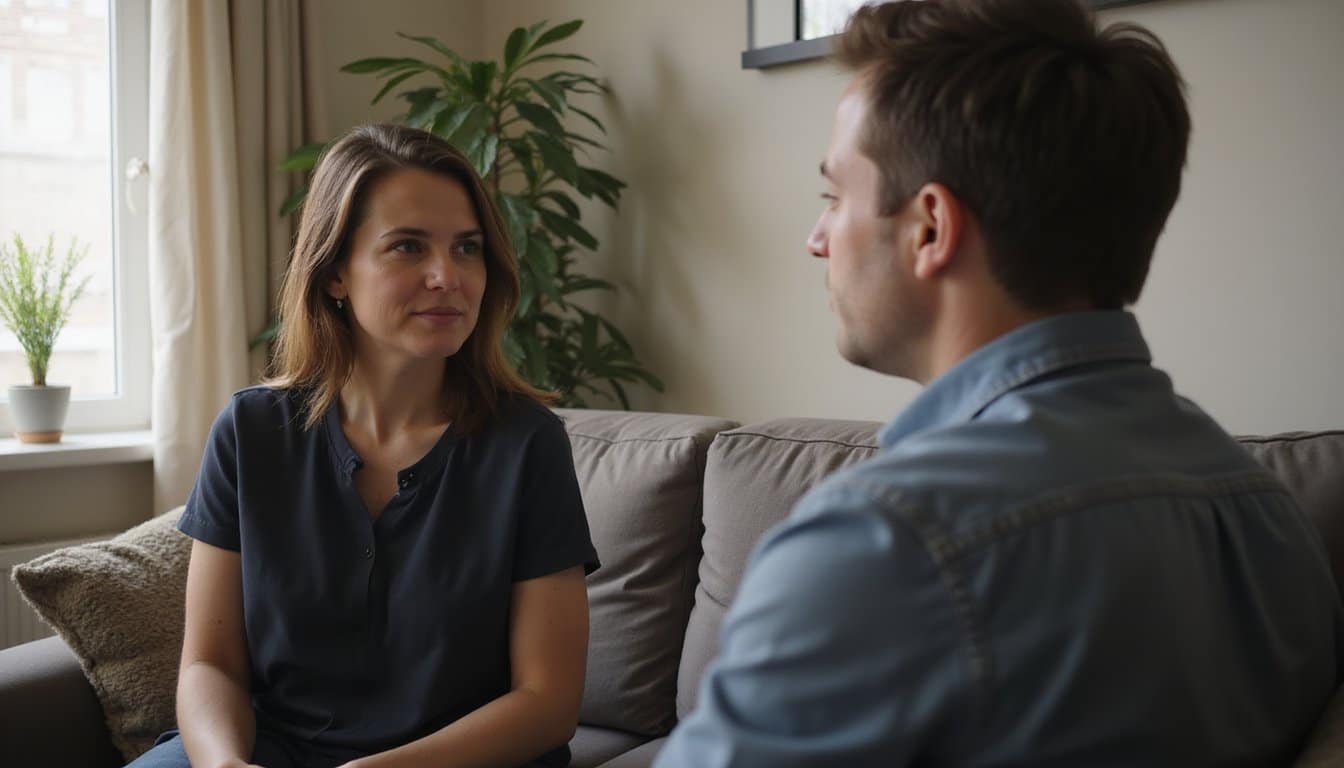
Understanding your partner’s triggers begins with recognizing common patterns, sensory cues, interpersonal dynamics, or environmental situations that activate their trauma responses. You’ll notice these patterns emerge through careful observation of what precedes emotional dysregulation, whether that’s certain tones of voice, unexpected touch, or feelings of being trapped or dismissed. Creating a safe dialogue space where your partner can share their trigger awareness without judgment allows you both to develop a collaborative approach to prevention and response.
Recognizing Common Trigger Patterns
Recognizing your partner’s triggers requires careful observation without assumption, since trauma responses often follow patterns that become visible over time. External sensory triggers like loud sounds, bright lights, or specific smells can activate distress before your partner consciously registers the stimulus. Crowded spaces and locations resembling past trauma sites may provoke similar reactions.
You’ll notice behavioral signs accompanying activation: slouching posture, poor eye contact, hypervigilance, or sudden numbness. Your partner might display excess energy or dissociate entirely.
Emotional triggers often involve feeling misunderstood, invalidated, or experiencing boundary violations. Internal triggers include anniversary dates, intrusive thoughts, and shame spirals.
Track these patterns through journaling and body awareness. Notice which stimuli consistently precede distress. This knowledge helps you respond supportively rather than reactively when triggers emerge.
Creating Safe Dialogue Space
When you want to help identify your partner’s complex PTSD triggers, creating a safe dialogue space becomes essential before any direct conversation about painful material.
Start by choosing a calm, private environment free from sensory overwhelm like bright lights or loud sounds. Let your partner know they control the conversation’s pace and can stop at any time. This autonomy reduces feelings of helplessness that often activate trauma responses.
When explaining PTSD to a partner or discussing triggers together, use a regulated tone and avoid pressing for details. You’re gathering information, not conducting an interrogation. Ask open-ended questions about what environments, emotions, or situations feel unsafe.
Validate their experiences without judgment. Your consistent, predictable presence builds the emotional safety necessary for honest disclosure about trigger patterns.
Create a Trauma Response Plan Together
Working with your partner to create a trauma response plan transforms reactive moments into opportunities for collaborative support. You’ll identify specific triggers together, establish grounding techniques that work for your partner’s unique nervous system, and develop safety signals that communicate needs without requiring extensive verbal processing during distress. This structured approach replaces guesswork with clear, agreed-upon responses that help both of you feel more confident traversing difficult moments.
Identify Triggers Together
Identifying triggers together forms the foundation of a trauma response plan that protects both partners from unnecessary distress. When learning how to support a partner with PTSD, recognize that triggers may include loud noises, raised voices, unexpected touch, crowded spaces, or heated arguments.
These situations can sometimes lead to emotional flashbacks in relationships, where past trauma responses are activated in present interactions, causing intense emotional reactions that may seem disproportionate to the situation. Watch for behavioral signs like avoidance, disproportionate emotional responses, physical stress symptoms, hypervigilance, or emotional shutdown.
Encourage open discussion about situations, people, and places that activate trauma responses. Journaling helps track potential triggers, including subtle cues like specific smells, songs, or seasons. Document these patterns together and establish safe words or signals for moments of distress.
Collaborate on response strategies for specific scenarios. Practice co-regulation techniques and integrate professional therapy into your trigger management approach. Predictable routines minimize unexpected activations and strengthen relationship stability.
Plan Grounding Techniques
Once you’ve mapped your partner’s triggers, the next step involves building a toolkit of grounding techniques that interrupt trauma responses before they escalate. Learning how to deal with someone with PTSD in a relationship means having practical interventions ready.
The 5-4-3-2-1 sensory technique anchors your partner in the present moment by identifying five visible things, four touchable items, three sounds, two smells, and one taste. Physical methods include clenching and releasing fists, pressing palms together, or carrying a grounding object.
For cognitive approaches, try spelling names backwards or counting by sevens. Your partner might respond to imagery strategies like visualizing a safe forest scene or reciting comforting verses. Test these techniques during calm periods so they’re accessible during actual distress.
Establish Safety Signals
When trauma responses strike, predetermined safety signals give both partners a shared language that bypasses the need for complex communication during high-stress moments. Living with someone with PTSD means recognizing that verbal expression often becomes difficult during activation. Simple, agreed-upon cues allow your partner with PTSD to communicate needs without extensive explanation.
| Signal Type | Example | Meaning |
|---|---|---|
| Verbal | “Yellow light” | Need space, not rejection |
| Physical | Hand on heart | Feeling overwhelmed |
| Visual | Specific object placed visibly | Request grounding support |
Understanding how to help spouse with PTSD includes establishing these signals during calm periods. When my partner has PTSD-related triggers, these predetermined cues interrupt fear responses and transfer safety information efficiently, reducing misunderstandings during vulnerable moments.
How to Listen Without Jumping to Solutions
Someone sharing their traumatic experiences doesn’t always need you to fix what’s broken, they often need you to witness what happened. Active listening means maintaining attentive focus without rushing toward solutions or reactions. This approach fosters emotional connection and increases your partner’s sense of safety.
A trauma-informed partnership requires specific empathic listening behaviors: genuine presence, thoughtful questioning, reflection, and validation. These actions signal acceptance and emotional safety, activating the social engagement system that trauma often disrupts.
Research shows that perceived partner responsiveness correlates with stronger PTSD symptom reduction over time. However, balance matters. Excessive stress communication, constantly discussing traumatic content, can actually worsen symptoms. Instead, focus on collaborative processing. Ask what your partner needs before responding. Sometimes holding space without offering answers provides exactly what healing requires.
Reading the Signals: When They Need Space vs. Closeness

How do you know whether your partner needs distance or connection when their signals seem contradictory? Trauma creates a push-pull dynamic where your partner may crave closeness while simultaneously fearing it. Learning to distinguish these cues prevents misattunement.
| Signal Type | Needs Space | Needs Closeness |
|---|---|---|
| Verbal | Shortened responses, topic avoidance | Asks questions, shares worries |
| Physical | Pulls away, restless movements | Seeks proximity, initiates touch |
| Emotional | Numbness, irritability, shutdown | Hyperawareness of your mood, vulnerability |
The worst thing to do to someone with PTSD is assume withdrawal means rejection. Often, it’s a protective response. Watch for small reconnection bids, brief eye contact or sitting nearby, that signal readiness without requiring verbal initiation.
Your Role in Their Therapy: Without Overstepping
Boundaries define the difference between being a supportive partner and becoming an untrained therapist, a distinction that protects both of you. Your role involves encouragement, comfort, and presence, not trauma processing or diagnostic interpretation.
Your role is encouragement, comfort, and presence, not becoming your partner’s therapist.
Effective ptsd spouse support means learning about the condition without attempting to treat it. You can research therapists together, accompany them to sessions if welcomed, and offer comfort without forcing difficult conversations. These actions complement professional treatment rather than supersede it.
Research shows couples therapy dropout rates are vastly lower than individual exposure therapy alone, highlighting how relationship support motivates recovery. However, attempting to “fix” trauma yourself increases caregiver burden and relationship strain.
Step back during triggering moments. Encourage treatment exploration without ultimatums. Your sustained emotional availability matters more than any intervention you could attempt.
Protect Your Own Mental Health as a Partner
While your focus naturally centers on your partner’s healing, the psychological toll of loving someone with PTSD demands equal attention to your own wellbeing. Research shows partners frequently experience anxiety, depression, sleep disruption, and social isolation.
These patterns are often discussed when examining complex ptsd symptoms in relationships, where trauma can influence both partners’ emotional states and coping behaviors. You may notice yourself mirroring your partner’s symptoms, developing hypervigilance, avoiding triggers, or experiencing emotional overwhelm.
| Warning Signs in You | Protective Actions |
|---|---|
| Anxiety, sleeplessness | Seek personal therapy |
| Social withdrawal | Maintain outside relationships |
| Guilt, low mood | Set sustainable boundaries |
| Feeling “at end of tether” | Access professional support |
Don’t dismiss your distress as secondary. Studies confirm that partners of individuals with severe PTSD symptoms show increased psychological dysfunction and decreased relationship satisfaction. Your mental health isn’t selfish, it’s essential for sustainable caregiving.
Get the Support You Deserve Right Now
Frequently Asked Questions
How Do I Apologize if I Accidentally Trigger My Partner’s Trauma Response?
Wait until your partner returns to a calm state before apologizing, attempting conversation during heightened activation can intensify their trauma response. When you do apologize, acknowledge their experience without accepting unwarranted blame, which reinforces shame. Say something like, “I see that was hard for you, and I’m sorry it happened.” Focus on the specific moment, avoid rehashing past incidents, and collaboratively discuss how you’ll navigate similar situations together.
Can My Partner’s PTSD Symptoms Worsen Because of Our Relationship Dynamics?
Yes, your relationship dynamics can worsen your partner’s PTSD symptoms. Research shows PTSD and relationship distress reinforce each other bidirectionally, meaning unhealthy patterns intensify symptoms over time. Demand/withdraw cycles, mismatched support levels, and unresolved conflict perpetuate trauma responses. If you’re overaccommodating during high distress or underresponding during low distress, you may unintentionally increase their avoidance. Recognizing these patterns isn’t about blame, it’s about understanding how you can break cycles together.
Should I Tell Friends or Family About My Partner’s PTSD Diagnosis?
You shouldn’t disclose your partner’s PTSD diagnosis without their explicit consent. Discuss together who to tell and what to share, respecting their autonomy and concerns about stigma. When you do share, with permission, you’ll often gain emotional support, practical help, and reduced isolation. However, prepare for mixed reactions; some people may respond with blame or misunderstanding. Educating trusted individuals about PTSD beforehand helps them respond more supportively and reduces potential harm.
How Do I Handle Intimacy When Trauma Affects My Partner’s Physical Boundaries?
You’ll want to prioritize ongoing consent conversations and let your partner guide the pace. Ask what feels safe before initiating touch, and establish clear signals for pausing or stopping. Consider exploring intimacy outside traditional settings if certain environments trigger distress. Recognize that avoidance often stems from protective mechanisms, not rejection of you. Building trust requires patience, focus on emotional connection first, and let physical closeness develop gradually as safety increases.
What Should I Do if My Partner Refuses to Acknowledge Their Trauma?
You can’t force acknowledgment, pushing often intensifies shame and avoidance. Instead, focus on creating emotional safety without demanding disclosure. Express concern gently, then step back. Model healthy coping and maintain your own support network. Recognize that denial often serves self-protection, especially when stigma feels threatening. If avoidance blocks treatment access, consider couples therapy where a professional can navigate resistance. Prioritize connection over confrontation while protecting your own wellbeing.